Subscribe to out newsletter today to receive latest news administrate cost effective for tactical data.

Let’s Stay In Touch

Shopping cart

Subtotal $0.00

View cartCheckout

Normal Labor and Delivery

  • Home
  • Normal Labor and Delivery

Normal Labor and Delivery

Normal labor is the natural process by which a full-term pregnancy (usually around 37–42 weeks) ends with the spontaneous onset of regular uterine contractions that lead to the progressive dilation of the cervix, expulsion of the fetus, placenta, and membranes through the birth canal — without complications for the mother or baby.

Stages of Labor

Stage 1: Cervical Dilation

  • Begins with the onset of regular uterine contractions.
  • Ends when the cervix is fully dilated to 10 cm.
  • Phases:
    • Latent Phase: Slow cervical dilation up to 4 cm.
    • Active Phase: Rapid dilation from 4 to 10 cm.
  • Average duration:
    • Primigravida (first pregnancy): ~12–14 hours
    • Multigravida (subsequent pregnancies): ~6–8 hours

Stage 2: Delivery of the Baby

  • Starts from full cervical dilation (10 cm) and ends with the delivery of the baby.
  • Duration:
    • Primigravida: up to 2 hours
    • Multigravida: 30 minutes to 1 hour
  • The mother uses bearing-down efforts with contractions to expel the baby.

Stage 3: Delivery of Placenta

  • Begins immediately after the birth of the baby.
  • Ends with the expulsion of the placenta and membranes.
  • Duration: usually 5–15 minutes.
  • Signs of placental separation: gush of blood, lengthening of the umbilical cord, and a rise of the uterus in the abdomen.

Stage 4: Immediate Postpartum Period

  • The first hour after delivery of the placenta.
  • Close monitoring of the mother for uterine contraction, bleeding, blood pressure, and pulse to detect postpartum hemorrhage early.

Mechanism of Normal Delivery (Mechanism of Labor)
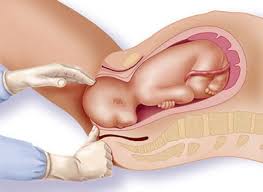
The process by which the fetus passes through the birth canal involves a series of movements known as cardinal movements:

  1. Engagement – The fetal head enters the pelvic inlet.
  2. Descent – The head moves downward through the pelvis.
  3. Flexion – The fetal chin moves toward the chest, presenting the smallest diameter.
  4. Internal Rotation – The head rotates to align with the maternal pelvis.
  5. Extension – The head extends as it passes through the vaginal outlet.
  6. External Rotation (Restitution) – The head realigns with the shoulders.
  7. Expulsion – The rest of the body is delivered smoothly.

Immediate Newborn Care
Right after birth, essential newborn care focuses on ensuring warmth, breathing, and bonding:

  1. Airway, Breathing, Circulation (ABC):
    • Clear airway if needed.
    • Dry the baby and assess breathing.
    • Start neonatal resuscitation if the baby doesn’t cry.
  2. Thermal Protection:
    • Immediate drying with a clean towel.
    • Skin-to-skin contact with the mother.
    • Cover the head with a cap.
  3. Cord Care:
    • Clamp and cut the umbilical cord after 1–3 minutes (delayed cord clamping helps improve baby’s iron levels).
  4. Apgar Score Assessment:
    • At 1 and 5 minutes after birth (Appearance, Pulse, Grimace, Activity, Respiration).
  5. Identification & Security:
    • Labeling, footprints, and ensuring the baby is returned to the correct mother.
  6. Breastfeeding:
    • Initiate exclusive breastfeeding within the first hour of life.
  7. Examine the Baby:
    • Check for congenital anomalies or birth injuries.

Summary
Normal labor is a natural, physiological event divided into four stages. Proper understanding of the stages, mechanism, and immediate care ensures safety for both the mother and newborn. Skilled monitoring and timely intervention are essential to achieve a healthy delivery outcome.